Install
Requirements
- x86_64 Linux with systemd and
/dev/kvm. Tested on Rocky Linux 9.6 and Ubuntu 24.04. - A blank disk for microVM disks, 100 GB or more. The installer wipes it.
- RAM for every microVM that runs at once, plus 1 GB for the host. With the defaults, 4 parallel
jobs and 2 pool VMs at 2 GB and up to 4 builders at 8 GB (
builder.max×builder.memory_mb), that is((4 + 2) × 2 GB + 4 × 8 GB) × 1.05 + 1 GB, about 47 GB. On a smaller host, lowerbuilder.maxorbuilder.memory_mb; see Sizing a host. Jobs that do not fit wait for memory. - Space on the host file system (not the blank disk) for saved builder caches in
/var/lib/firerunner/builder-cache: up tobuilder.saved_cache_gb(100 GB), and never so much that the file system has less than 10% free. - GitLab 16 or newer.
On a VM host, turn on nested virtualization first:
- VMware: power off, then Expose hardware assisted virtualization to the guest OS.
- KVM or Proxmox:
kvm_intel nested=1and CPU typehost.
Check with ls /dev/kvm.
Install
curl -sfL https://raw.githubusercontent.com/ismoilovdevml/firerunner/main/install.sh | sudo bash
The installer checks every download against its sha256, sets up the thin pool, the microVM network, the image and cache servers and the services, then verifies them. You can run it again: it only restarts what changed, and it reloads the microVM firewall in place without touching running VMs.
Options go before bash, for example sudo FR_DISK=/dev/sdb bash:
| Variable | Default | |
|---|---|---|
FR_DISK |
first blank disk | disk for microVM disks, wiped |
FR_VM_DISK |
40GB |
root disk of each microVM, thin-provisioned |
FR_THIN_CHUNK |
64K |
chunk size of a new thin pool: a VM's first write to a chunk copies or zeroes all of it; an existing pool keeps its size |
FR_POOL_SIZE |
FR_RUNNER_CONCURRENT |
pre-booted microVMs; given on a re-run, it replaces pool.size |
FR_REGISTRY_MIRRORS |
ghcr.io,quay.io,registry.k8s.io,mcr.microsoft.com |
registries mirrored on the host besides Docker Hub; remembered for later runs, none for none |
FR_VM_VCPU |
host CPUs / FR_RUNNER_CONCURRENT, 2 to 16 |
vCPUs of each job microVM; given on a re-run, it replaces vm.vcpu |
FR_VERSION |
edge |
firerunner release to install: edge (the latest main) or a version tag |
FR_ALLOW_UNSIGNED |
none | 1 installs v0.1.0 or v0.1.1, published before releases were signed. Every other release needs a valid signature |
FR_CACHE_DAYS |
14 |
cache: archives not written for this many days are deleted |
FR_METRICS_ALLOW |
none | CIDR that may scrape :9477; without it metrics stay local. Kept for later runs |
FR_EGRESS_DENY |
none | comma-separated CIDRs jobs must not reach, e.g. 192.168.0.0/16. Kept for later runs; none clears it |
FR_GITLAB_URL, FR_RUNNER_TOKEN |
none | register the runner during install |
FR_RUNNER_CONCURRENT |
4 |
parallel jobs of the runner registered during install |
FR_SUBNET |
10.200.0 |
/24 for microVMs |
FR_BRIDGE |
br-fc |
bridge the microVMs are attached to |
FR_PROXY, FR_NO_PROXY, FR_CA_FILE, FR_INSECURE_REGISTRIES |
none | behind a proxy or with internal registries: see Corporate networks |
Connect GitLab
- In GitLab, create a runner: Settings → CI/CD → Runners → New runner (project, group or
instance). Tag:
firecracker. Leave Run untagged jobs off. -
Register it on the host:
sudo firerunner runner register --url https://gitlab.example.com --token - # paste the glrt-... token -
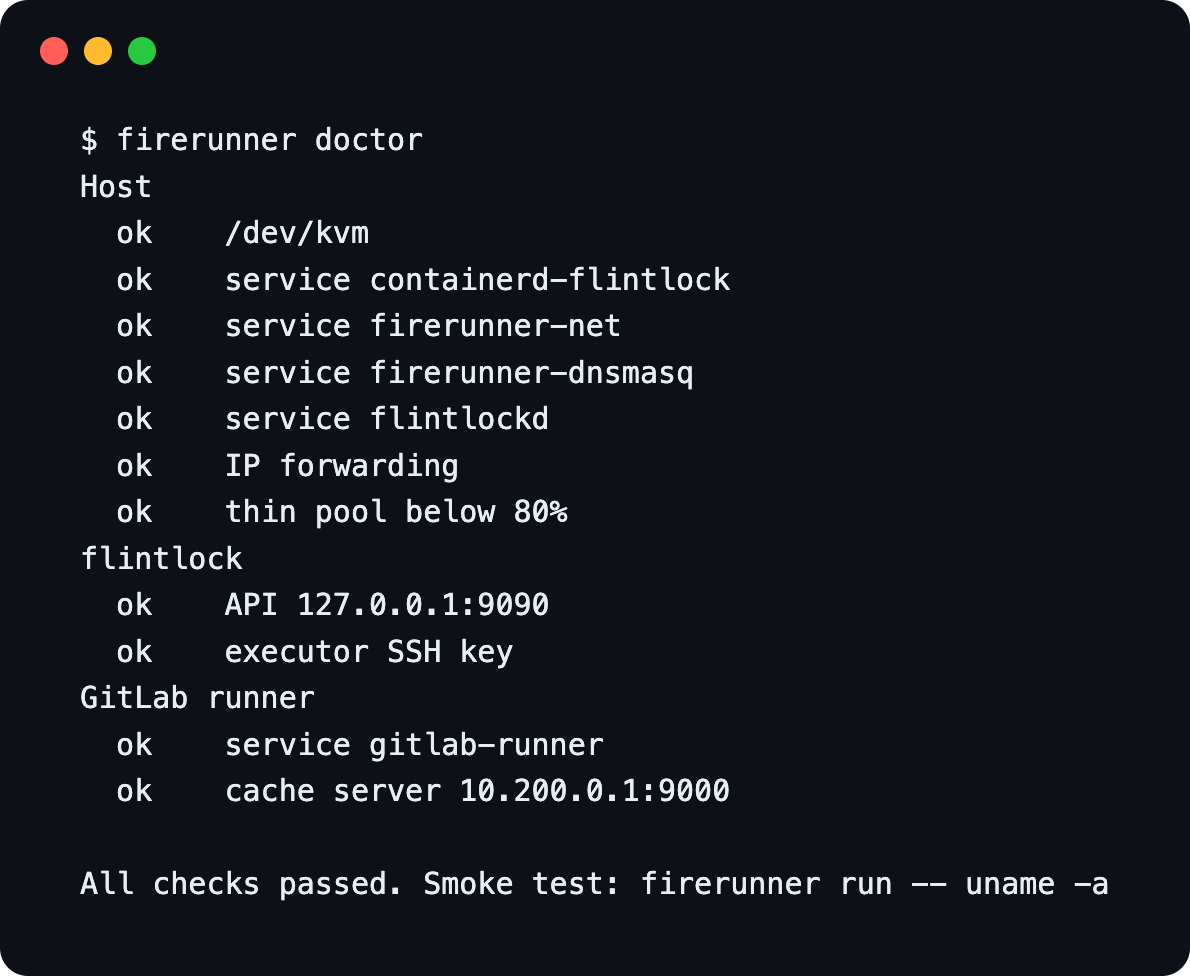
Check:
sudo firerunner doctor               # every check "ok"
sudo firerunner run -- uname -a      # boots a throwaway microVM
For more hosts, install and register each one; GitLab spreads jobs over them.
Uninstall
curl -sfL https://raw.githubusercontent.com/ismoilovdevml/firerunner/main/install.sh | sudo bash -s -- uninstall
It deletes the microVMs and removes services and binaries (containerd's binaries stay). The disk,
images, /var/lib/firerunner and /etc/firerunner stay; the command prints how to remove them.
Delete the runner in GitLab yourself.